The Great Courses has 635 audiobooks on Listento.it, narrated by 479 narrators, with an average listener rating of 4.5★ across 19,831 ratings. The most-rated is A Column of Fire.

How the Crusades Changed History
Summary
Centuries have passed since the last crusader knight laid down his sword, but the Crusades continue to hold sway over our world. Because the Crusades have been so consequential to history, it's essential to understand the context, motivations, and preconditions of these dramatic military campaigns. In doing so, you'll not only get a fresher understanding of the Crusades, you'll discover surprising truths about why (and how) they were fought. More than just an enriching recount of events, this series of 24 lectures is an intellectually rewarding exploration of how the Crusades shaped the medieval world and laid the seeds for our own. Plunging you into the series of Crusades to the Holy Land and elsewhere - from the calling of the First Crusade in 1095 to the collapse of the Kingdom of Jerusalem, in 1291 - Professor Daileader's lectures are filled with eye-opening insights and gripping stories that will help you reach your own conclusions about just how important these centuries of warfare were to the story of human civilization. PLEASE NOTE: When you purchase this title, the accompanying reference material will be available in your Library section along with the audio.
©2013 The Teaching Company, LLC (P)2013 The Great Courses

Archaeology: An Introduction to the World's Greatest Sites
Summary
The work of archaeologists has commanded worldwide attention and captivated the human imagination since the earliest days of exploration, with groundbreaking discoveries such as the treasures of ancient Egypt, the lost kingdoms of the Maya, and the fabled city of Troy. Archaeology brings us face-to-face with our distant ancestors, with treasures of the past, and with life as it was lived in long-ago civilizations. Despite the fascinating and often romantic appeal of archaeology, many of us have little idea of what the field actually involves. What, exactly, do archaeologists do? What takes place on an archaeological dig? And how does the reality of the work differ from what we see in Indiana Jones movies? Archaeology: An Introduction to the World's Greatest Sites, taught by renowned archaeologist and National Geographic Explorer Eric H. Cline, answers these questions and more in rich and provocative detail. These 24 thrilling lectures, produced in partnership with National Geographic, introduces you to over 20 of the most significant and enthralling archaeological sites on the planet, providing both in-depth looks at the sites themselves and an insider's view of the history, science, and technology of archaeology. Prepare yourself for a vivid and detailed exploration of archaeology's most magnificent discoveries in the company of an expert archaeologist with decades of experience in the field.
©2016 The Great Courses (P)2016 The Teaching Company, LLC

Mystical Tradition: Judaism, Christianity, and Islam
Summary
Each of the great three Abrahamic religious traditions holds the seeds for deep mystical contemplation. But what do most of us know about these mystics and the tradition they sustained? Explore this spiritual, literary, and intellectual heritage in these great faiths of the West as it unfolds over three millennia with these 36 enlightening, thought-provoking lectures that offer nearly unprecedented access to these seldom-studied traditions. By laying the mystical traditions of Judaism, Christianity, and Islam side by side, Professor Johnson offers a unique opportunity to compare and contrast the many forms of religious experience in the West. Starting with the most ancient texts of the Hebrew Bible, Professor Johnson traces the emergence, growth, and persistence of mystical thought in many countries and in many ages. Bringing together the disciplines of philosophy, history, literature, and religious studies, these lectures offer a nuanced and insightful examination of Western spirituality-one that contributes not only to a fuller understanding of our religious traditions, but to our shared culture and history as well. As you examine the mystical experience, you'll see how, again and again, Western mystics have sought the answers to a few fundamental questions: What is the nature of reality? What is the relationship between humankind and the divine? Can human beings ever attain full knowledge of creation? What emerges from exploring these potent spiritual and intellectual questions is a picture of Western mysticism as diverse, multifaceted, and ever-developing. PLEASE NOTE: When you purchase this title, the accompanying reference material will be available in your Library section along with the audio.
©2008 The Teaching Company, LLC (P)2008 The Great Courses

Warriors, Queens, and Intellectuals: 36 Great Women Before 1400
Summary
Throughout history, women have played integral roles in family, society, religion, government, war - in short, in all aspects of human civilization. Powerful women have shaped laws, led rebellions, and played key roles in dynastic struggles. Some were caught up in forces beyond their control, while others manipulated and murdered their way to the top. However, unearthing their stories from the historical record has been a challenge, with the ordinary difficulties of preserving information across the generations increased by centuries of historical bias and gendered expectations. Women, when they were mentioned at all, often filled the role of virtuous maiden, self-effacing mother, or seductive villain. Imagine what you are missing when only half the story is being told. In Warriors, Queens, and Intellectuals: 36 Great Women Before 1400, taught by Professor Emerita of Humanistic Studies Joyce E. Salisbury, you will experience another side of history, one that has often been overlooked. In these 36 lectures, women step out from the footnotes and sidebars of traditional history and into the spotlight, illuminating the dark corners of the pre-modern world along the way. From thwarted daughters and ambitious wives to fearless revolutionaries and brilliant philosophers, you will see how women have played diverse roles throughout history and why their influence is so vital to a fuller understanding of the world we live in today. Beginning at the start of the Roman Empire and carrying you through to the end of the Middle Ages, Professor Salisbury will introduce you to dozens of influential women from all across the globe. PLEASE NOTE: When you purchase this title, the accompanying PDF will be available in your Audible Library along with the audio.
©2019 The Great Courses (P)2019 The Teaching Company, LLC

Take My Course, Please! The Philosophy of Humor
Summary
In recent decades, the philosophy of humor has been recognized as a legitimate subfield of philosophy. The reason for this? Because to understand how humor works is to better understand the nature of human experience. In these 24 insightful, informative, illuminating, and (yes) humorous lectures, explore the philosophical theories and explanations of humor, from blatantly obvious puns to complex narratives to sly twists of language. Rooted in analytic philosophy, the natural and social sciences, and the observations of thinkers ranging from Aristotle and Jonathan Swift to Sigmund Freud and Robert Latta, these lectures will leave you with a stronger appreciation of the jokes you tell and the jokes you hear. You’ll ponder the possible universality of humor in history and culture, the debate over humor’s objectivity or subjectivity, and the complex relationship between humor and tragedy. You’ll also unpack each of the six existing theories of humor, including the superiority theory (in which to joke is to mock and put someone beneath your level) and play theory (in which humor is a species of the phenomenon of play). You don’t need a philosophy degree to explore the philosophy of humor. All you need is an open mind. (A funny bone or two helps as well.) PLEASE NOTE: When you purchase this title, the accompanying PDF will be available in your Audible Library along with the audio.
©2018 The Great Courses (P)2018 The Teaching Company, LLC

Exploring the Roots of Religion
Summary
What impulse drove ancient cultures to create sites like Stonehenge, Machu Picchu, and the pyramids at Giza? Why are we so transfixed by their presence today? And what do they reveal about our ancestors-and humanity? The dynamic force of religious belief is responsible for some of the world's most popular and ancient locales.With these 36 riveting lectures, you can dig through the earth and learn how sacred buildings, complexes, tomb structures, artwork, and more have provided us with unparalleled knowledge about early spiritual experiences around the world. Using the tools and knowledge of their field, archaeologists can now determine the nature of a sacrificial ritual, compare the visible attributes of ancient deities, and map out the orientation of a temple or tomb. Professor Hale gives you a comprehensive look at specific religious archaeological sites around the world-inside caves and crypts, through vast deserts and ancient cities, from Polynesia to Mexico to the American Midwest. Studying these breathtaking sites such as Lascaux Cave, Machu Picchu, and Easter Island, you learn the points of interest that attract the attention of archaeologists and scholars, survey the principal features unearthed during the site's excavation, discover what evidence at the site reveals about the evolution of religion, and more. By the final lap of your international journey, you'll have developed a new vision of religion and its crucial role in ancient history. You'll become more attuned to spirituality's universal elements and its unique characteristics. And you'll realize just how much credit religion deserves for remarkable sites that continue to captivate us. PLEASE NOTE: When you purchase this title, the accompanying reference material will be available in your Library section along with the audio.
©2009 The Teaching Company, LLC (P)2009 The Great Courses

Forensic History: Crimes, Frauds, and Scandals
Summary
Modern history is filled with terrible crimes, baffling hoaxes, and seedy scandals. The infamous Jack the Ripper slayings. The alleged survival of Anastasia Romanov, the youngest daughter of the murdered Tsar. Seven-time Tour de France winner Lance Armstrong's public fall from grace. The Chicago Tylenol poisonings and the copycat crimes that followed. Step into the world of forensic science and study the most fascinating crimes and mysteries from the last two centuries in the 24 lectures of Forensic History: Crimes, Frauds, and Scandals. Professor Murray, a forensic anthropologist with nearly 30 years of experience in the field, has crafted lectures that are a remarkable blend of storytelling and science - a whirlwind tour that takes you from the gas-lit streets of Victorian London to small-town America. As you journey around the world and into the past, you'll re-examine modern history's great crimes and scandals using the tools and insights of forensic science. In doing so, you'll learn how cutting-edge advancements in science and technology are applied to investigations and how to evaluate evidence and think like a forensic scientist. Using her extensive background in the field and her skill at weaving riveting stories, Professor Murray invites you peer over the shoulders of investigators as they examine some of the most famous crimes in history, as well as cases that shed light on what happens when the justice system goes awry. Whether they're controversial or by-the-book, solved or unsolved, hot or cold, these cases are an opportunity to gain deeper insight into the historic and cutting-edge methods and tools forensic scientists use on the job. Having participated in hundreds of investigations in America and abroad, Professor Murray intersperses these historical examinations with some of her own, equally intriguing, personal experiences. PLEASE NOTE: When you purchase this title, the accompanying reference material will be available in your Library section along with the audio.
©2014 The Teaching Company, LLC (P)2014 The Great Courses
Europe and Western Civilization in the Modern Age
Summary
Only three lifetimes ago, Europe was a farming society ruled by families of monarchs. But with two seismic tremors-capitalism and democracy-Europe's economic and royal foundations were shattered forever and modern European history began. In this series of 48 fascinating lectures, Professor Childers makes the history of Europe from the 1750s to the present-events both horrible and magnificent-as immediate as today's headlines, employing the historian's craft and a storyteller's skill to find the causes of what otherwise could seem to be the march of folly. The result is an intellectually exhilarating journey through a period of three lifetimes such as the world had never experienced. You'll see how in the span of just one life, England became an industrial, urban culture; tens of thousands were guillotined in France; Napoleon's Empire - the greatest since Rome-rose and fell; and revolution swept the capitals of Europe; how in the span of just one more, the Russian serfs were freed; Italy and Germany were created from a loose collection of city-states; European powers divided and conquered Africa; Darwin, Marx, Freud, and Einstein published world-shaking ideas; and millions died in a Great War; and how in that third lifetime, the world was plunged into economic depression, global war, and genocide; Europe abandoned its African colonies; the Soviet Union rose and fell; Fascism and Communism failed as democracy became the dominant form of government; and the same European powers that had bled each other for hundreds of years created a Common Market and unified currency. PLEASE NOTE: When you purchase this title, the accompanying reference material will be available in your Library section along with the audio.
©1998 The Teaching Company, LLC (P)1998 The Great Courses

Masters of Mindfulness: Transforming Your Mind and Body
Summary
According to Dr. Shauna Shapiro, mindfulness means paying attention in the present moment with an attitude of kindness and generosity. It involves being aware and doing things with conscious intent. But research shows our mind lives in the past or the future almost half of our waking moments. Focusing on this moment in time, this place, your body as it feels in this moment, your breath as it moves in and out right now.... That focus on present-moment awareness has the capability to transform your life. And it has existed for thousands of years, interwoven throughout many religious and intellectual traditions. Mindfulness as a practice is very simple and its effects are well-documented. What many people don’t realize is the breadth of the science behind it and how much of our health - physical, mental, emotional - is bound up in the way we look at and experience the world. Now, modern biology and neuroscience can actually quantify many of the effects of mindfulness and you may be surprised by how powerful the impact can be. In Masters of Mindfulness, 11 top researchers and proponents of mindfulness discuss what modern science and contemporary research have revealed about this ancient practice and the many ways in which it can benefit your life. These 22 lectures present a unique and extraordinary opportunity, bringing a diverse group of renowned specialists together in one place for the first time to share their own personal experiences and their latest research, and to guide you through several mindfulness exercises. Acting as your primary guide through the many concepts and presenters, psychologist and mindfulness expert Dr. Shauna Shapiro brings together some of the greatest minds in the field to give you an immersive, 360-degree experience of mindfulness, its practice, and its benefits. This course was recorded on location at Esalen Institute in Big Sur, California, a place that is considered a unique sanctuary for anyone interested in the study of human consciousness and the human potential movement. Since 1962, this profoundly beautiful locale has been a thriving hub for investigating and experiencing the journey of mindfulness in its many forms, including cutting-edge scientific research and applications. Not everyone can hop on a plane to California, so Masters of Mindfulness brings this one-of-a-kind experience to you. Full list of authors: Shauna Shapiro, Rick Hanson, Kristine Carlson, Juna Mustad, Mike Robbins, Amishi Jha, Elissa Epel, Jessica Graham, Dacher Keltner, Wallace Nichols, Daniel Siegel, and The Great Courses. Full list of narrators: Shauna Shapiro, Rick Hanson, Kristine Carlson, Juna Mustad, Mike Robbins, Amishi Jha, Elissa Epel, Jessica Graham, Dacher Keltner, Wallace Nichols, and Daniel Siegel. PLEASE NOTE: When you purchase this title, the accompanying PDF will be available in your Audible Library along with the audio.
©2018 The Great Courses (P)2018 The Teaching Company, LLC

Business Law: Contracts
Summary
What is a contract? How can you make one binding? How can you avoid being prematurely bound by one? What remedies are available if someone breaches your contract? These questions and the other important issues of legally enforceable promises are covered in these eight lectures. As you'll learn in these eight lectures, contractual agreements are one of the principal mechanisms for ordering life in society. Professor Cross lays a comprehensive foundation in the practical and intricate body of law that governs contracts. Throughout his expertly delivered lectures, he guides you through a range of topics and issues and helps you finally make better sense of business contracts-in all their seemingly overwhelming complexity. You'll explore the boundaries of contracts in law, including the four main requirements that any contract must satisfy. You'll unpack the Uniform Commercial Code of the United States, which incorporated common law about commercial contracts into state statutes. You'll learn about the main components of a contract (such as the preliminary issues of offer and acceptance, the definiteness of a contract's terms, and the ability of parties to negotiate). You'll also review problems associated with the performance and enforcement of a contract, including how much of a performance is required to consider a contract discharged and the categories of persons who are permitted to enforce agreements. Please note: This course is not intended to provide financial or investment advice. All investments involve risk: Past performance does not guarantee future success. You acknowledge that any reliance on any information from the materials contained in this course shall be at your own risk. PLEASE NOTE: When you purchase this title, the accompanying reference material will be available in your Library section along with the audio.
©1994 The Teaching Company, LLC (P)1994 The Great Courses

The Skeptic's Guide to Alternative Medicine
Summary
Energy medicine. Acupuncture. Superfoods. Healing magnets. What does the scientific evidence really say about these and other "alternative medicine" treatments for personal wellness? How can we know if a natural remedy is safe and effective? How can people become their own best skeptical consumer of health news in the media? Join neurologist and science educator Dr. Steven Novella for a fascinating exploration of these and other important questions about the truths—and myths—behind alternative medicine. Perhaps the most important skill to have in this brave new world of ever-changing medical news is the ability to evaluate sources and information, and to think critically about how alternative medicine is marketed, regulated, and used. Dr. Novella takes a rigorous, science-based approach in exploring so-called "popular" and "cutting-edge" trends. Armed with this knowledge, listeners will be in a much better position to assess alternative pathways to physical health. Dr. Novella’s 10 leading-edge lectures will answer such questions as: Do magnetic fields really have useful biological properties? Why is chiropractic treatment no more effective for pain management than simple physical therapy? Can brain games truly make one smarter or help in staving off dementia? Can homeopathic remedies, such as those derived from plants and minerals, really cure ailments? Does cupping therapy really help to reduce pain and inflammation, while increasing blood flow? Dr. Novella provides insights on the ever-widening gap between alternative medicine and scientific medicine, giving listeners the confidence they need to become their own best health advocates.
©2019 Audible Originals, LLC (P)2019 Audible Originals, LLC.

Becoming a Great Essayist
Summary
If you have a clever anecdote, an interesting memory, a new way to explain how something works, or an opinion on a social or political issue, then you have an essay in you. Unlike a novel, history book, or scientific publication, essays provide you with the versatility to express all the various facets that make you you. The concise and direct nature of an essay means that you may tap in to your sense of wit, share your individual point of view, persuade others to your perspective, and record a part of your memories for future generations in as many distinct essay forms as you wish. The essay is, above all else, one of the most profoundly personal outlets for writing. Discover the keys to unlocking your potential in essay writing with Becoming a Great Essayist. These 24 illuminating lectures explore numerous genres or types of essays, challenge you with stimulating writing prompts, and provide insights into how to get to know yourself like never before so that you may write honest, compelling, and great essays. And because essays are so flexible in their style and function, the skills you build writing great essays may be applied to almost all other forms of writing. While the goal of this course is to provide you with fundamental abilities that will improve your essays, the skills you will learn also provide a foundation to develop any writing project you undertake. This is an unrivalled opportunity to advance your critical and creative thinking skills, enhance your ability to master a strong and persuasive style, and, most importantly, get to know your own inner voice. PLEASE NOTE: When you purchase this title, the accompanying reference material will be available in your My Library section along with the audio.
©2016 The Teaching Company, LLC (P)2016 The Great Courses
How to Publish Your Book
Summary
With the advent of submission conveniences offered by the Internet, today's authors face unprecedented competition in the writing market. Adding to that the publishing market is in a constant state of flux, making publishers wary about taking on new authors. Further, a plethora of options for publication make navigating the increasingly complex publishing industry harder than ever. So, how does an aspiring author get published? Learning the ropes, understanding how publishing works, and having someone who can help you navigate this convoluted system will make all the difference between a manuscript sitting on your closet shelf - or sitting on the top of the best-sellers shelf. In 24 eye-opening lectures, Jane Friedman, publishing industry expert and educator, provides you with sought-after secrets of the publishing process that will help you navigate this difficult progression, bypass pitfalls that many novice authors get hung up on, and improve your chances of being considered for publication. She acts as your personal guide though the entire process: from finalizing your manuscript to writing the perfect pitch to reviewing contracts and marketing your book. She provides the candid scoop on what you need to do in order to increase your chances of being considered. The knowledge you'll gain by having an inside expert teaching you how to position your book for publication gives you a unique advantage and drastically increases your chances of getting noticed in this increasingly competitive industry. The reality is that there is no magic formula that will guarantee publication. There are, however, numerous things that you can do to improve your chances and streamline your path to success. Get extensive insights into the publishing process that will help you avoid the most common mistakes and pitfalls that many authors encounter. This course lays out your best options for publication and leads you step by step toward achieving your goals. PLEASE NOTE: When you purchase this title, the accompanying reference material will be available in your Library section along with the audio.
©2015 The Great Courses (P)2015 The Teaching Company, LLC

Questions of Value
Summary
We live in a world seemingly dedicated to questions of fact and finance. What should I invest in? What school district is the house in? But the fundamental questions of our lives are actually questions of value: What makes life worth living? Are there values that transcend cultural differences? Is all value subjective? If you've ever felt the tug of such questions - or if you just want to fine-tune your ability to see how deeper questions of ethics and values apply to the choices that make up our lives - these 24 lectures bring to life the insights of thinkers and artists who have grappled with these questions for thousands of years. Socrates said, "The unexamined life is not worth living." To examine these questions, Professor Grim casts a wide net, drawing from history, theoretical economics, game theory, theoretical biology, and sociobiology - with a few forays into physics, anthropology, and psychology. But it isn't only scientists and historians who ask us to consider our values. Writers as varied as Charles Dickens, Fyodor Dostoevsky, Ursula Le Guin, Mark Twain, Anne Rice, and Jorge Luis Borges have also delved into the meaning of life and the values we live by. In exploring the course's varied sources, Professor Grim takes great care to introduce each concept carefully so that each new concept builds on the last. His presentation - even of the most nuanced material - is consistently clear, even to those with no background in philosophy. PLEASE NOTE: When you purchase this title, the accompanying reference material will be available in your Library section along with the audio.
©2005 The Teaching Company, LLC (P)2005 The Great Courses
Foundations of Economic Prosperity
Summary
Prosperity has transformed the world. But the story of prosperity is far from simple-or complete. These 24 lectures give you an unrivaled overview of one of the most pressing issues of our day and take you behind the headlines and into the debates to dispel some common myths about prosperity and get at deeper truths. In this stimulating, wide-ranging course, Professor Drezner shows that achieving prosperity involves more than economics. Psychology, sociology, political science, and history also come into play. By taking this broad view, he leads you to fundamental insights about how the modern world works and an understanding of the functioning of the U.S., European, Chinese, and other major economies, as well as an appreciation for the special problems faced by underdeveloped nations. These lectures introduce you to dozens of case histories that illustrate what works and doesn't work in the drive to increase economic growth. A superb storyteller, Professor Drezner reaches back to examples such as the policy called mercantilism that trapped European powers in growth-killing trade practices from the 16th to 18th centuries. And he anchors his analysis in the present with discussions of globalization, financial bubbles, and other economic phenomena in the news.As a start on your own road to greater prosperity, educate yourself with this unparalleled explanation of the foundations of economic prosperity. PLEASE NOTE: When you purchase this title, the accompanying reference material will be available in your Library section along with the audio.
©2013 The Teaching Company, LLC (P)2013 The Great Courses

Thermodynamics: Four Laws That Move the Universe
Summary
Nothing has had a more profound impact on the development of modern civilization than thermodynamics. Thermodynamic processes are at the heart of everything that involves heat, energy, and work, making an understanding of the subject indispensable for careers in engineering, physical science, biology, meteorology, and even nutrition and culinary arts. Get an in-depth tour of this vital and fascinating science in 24 enthralling lectures suitable for everyone from science novices to experts who wish to review elementary concepts and formulas. Professor Jeffrey Grossman of MIT uses the four laws of thermodynamics as a launching point to discuss foundational concepts that are critical pillars of science and engineering - ideas such as entropy, chemical potential, Gibbs free energy, enthalpy, osmotic pressure, heat capacity, eutectic melting, and the Carnot cycle. These and other ideas shed light on many phenomena in the natural world, and they are the analytical tools that engineers use to create new devices and technologies. At the end of these lectures, you'll truly appreciate the elegance and importance of thermodynamic principles. Also, you'll have unlocked the secrets to a fascinating aspect of our universe. PLEASE NOTE: When you purchase this title, the accompanying PDF will be available in your Audible Library along with the audio.
©2014 The Great Courses (P)2014 The Teaching Company, LLC

Great Philosophical Debates: Free Will and Determinism
Summary
Do you make your own choices or have circumstances beyond your control already decided your destiny? For thousands of years, this question has intrigued and perplexed philosophers, scientists, and everyone who thinks deliberately about how they choose to live and act. For if free will makes us accountable for our choices, does the opposite hold true, that determinism absolves us of responsibility?The implications of how we resolve this great question can affect everything from the small choices we make every day to our perspective on criminal justice and capital punishment. Now you can begin - or continue - your own exploration of this fundamental issue in a series of thought-provoking lectures from an award-winning scholar acclaimed as one of the most innovative thinkers now working at the intersection of philosophy and psychology. Beginning with an explanation of the fundamental approaches to this debate, Professor Nichols prepares you for an in-depth study of the complexities of free will and determinism. You learn what great thinkers through the ages have believed about the choices we make and understand how we might deal with their implications. Professor Nichols looks at each side of every argument, creating a balanced perspective that invites you to come to your own conclusions about whether or not we control our lives. PLEASE NOTE: When you purchase this title, the accompanying reference material will be available in your Library section along with the audio.
©2008 The Teaching Company, LLC (P)2008 The Great Courses
The Conservative Tradition
Summary
A thorough understanding of Conservatism's lineage, principles, and impact on history is essential to making sense of the 21st-century political dialogue-a dialogue that consumes the television you watch, the newspapers you read, and the radio you listen to. No matter where you place yourself on the ideological spectrum, these 36 lectures will intrigue you, engage you, and maybe even provoke you to think about this political philosophy in an entirely new way. In crafting his exploration of just why this has happened, Professor Allitt has specifically designed his lectures to be objective, neutral, and intellectually satisfying for every viewer and listener - whatever their ideological outlook. Using an easygoing and engaging style, these lectures show you how Anglo-American Conservatism developed and evolved in both Great Britain and the United States; how traditional Conservatism produced evolutionary variants like Neoconservatism and Libertarianism; and the provocative ways in which Conservatism has interacted with differing political philosophies. Following the fascinating history of Conservatism, you'll also meet the widest possible range of thinkers and practitioners behind the Conservative tradition, including John Stuart Mill, Ayn Rand, Francis Schaeffer, Adam Smith, Henry Adams, Alexander Hamilton, William Pitt the Younger, Winston Churchill, Margaret Thatcher, Ronald Reagan, H.L. Mencken, William F. Buckley Jr., Ludwig von Mises, and Friedrich von Hayek.Whether you consider yourself a Liberal or a Conservative-or something in between-these lectures can make you a more effective and informed citizen, armed with a sharpened understanding of the ways in which this philosophy has influenced events around the world. PLEASE NOTE: When you purchase this title, the accompanying reference material will be available in your Library section along with the audio.
©2009 The Teaching Company, LLC (P)2009 The Great Courses
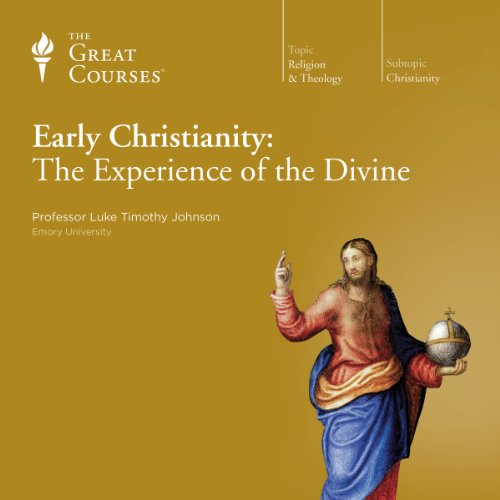
Early Christianity: The Experience of the Divine
Summary
After 2,000 years, Christianity is the world's largest religion and continues to prosper and grow. What accounts for its continued popularity? In these twenty-four lectures, Professor Johnson maintains that the most familiar aspects of Christianity-its myths, institutions, ideas and morality-are only its outer "husk." He takes you on a journey to find the "kernel" of Christianity's appeal: religious experience. You'll travel back to Christianity's origins during its first 300 years to identify the elements that first made it appealing and which still hold the secret to its ability to attract new followers. Professor Johnson employs scholarly techniques that have only recently been applied to religion. In introducing early Christian religious experience, Professor Johnson looks at questions that are new and intellectually exciting in the study of religion. Was Christ the founder of Christianity? Was Christianity's early growth due to his life and works or to his followers' powerful experience of his death and resurrection, their sense of having been transformed by the Holy Spirit? By combining such disciplines as history, the social sciences, and comparative literary analysis, you'll look at religious experience and behavior from a fresh perspective. You'll consider a variety of theories developed by the philosophers Alfred North Whitehead and Immanuel Kant, Emil Durkheim, the founder of sociology, and Sigmund Freud. And to better understand religious experience in Christianity, you'll also study it in the two religions with which early Christianity co-existed: Greco-Roman paganism and Judaism.
©2002 The Teaching Company, LLC (P)2002 The Great Courses

Books That Have Made History: Books That Can Change Your Life
Summary
Why do "Great Books" continue to speak to us hundreds and even thousands of years after they were written? Can they deepen our self-knowledge and wisdom? Are our lives changed in any meaningful way by the experience of reading them? Tackle these questions and more in these 36 engaging lectures. Beginning with his definition of a Great Book as one that possesses a great theme of enduring importance, noble language that "elevates the soul and ennobles the mind," and a universality that enables it to "speak across the ages," Professor Fears examines a body of work that offers extraordinary wisdom to those willing to receive it. You'll study dozens of works, from the Aeneid and the book of Job to Othello and 1984 - works that range in time from the 3rd millennium B.C. to the 20th century, and in locale from Mesopotamia and China to Europe and America. Professor Fears approaches each of these works from an entirely different direction, considering philosophical and moral perspectives that superbly complement a purely literary understanding.Grasping these philosophical and moral perspectives is crucial to the education of every thoughtful person. These works that have shaped the minds of great individuals, who, in turn, have shaped events of historic magnitude. You'll study the underlying ideas of each great work to see how these ideas can be put to use in a moral and ethical life."History is our sense of the past," Professor Fears says. "And these Great Books are our links to the great ideas of the past. They educate us to live our lives in a free and responsible way." PLEASE NOTE: When you purchase this title, the accompanying reference material will be available in your Library section along with the audio.
©2005 The Teaching Company, LLC (P)2005 The Great Courses