Jason Zenobia has narrated 119 audiobooks on Listento.it by 21 authors, with an average listener rating of 4.5★ across 24 ratings. The most-rated is History of Armenia.

Nuremberg Trials: A History from Beginning to End
Summary
Discover the remarkable history of the Nuremberg Trials... In 1933, the National Socialist German Workers’ Party, triumphant after the July 1932 elections, was the largest political party in Germany. The Nazis quickly banned all other political parties and, under the leadership of Adolf Hitler, proceeded to implement the policies which aroused the anti-Semitic sentiment of the German people. By 1933, the first concentration camp in Dachau was already in operation, punishing Jews, intellectuals, the mentally and physically handicapped, homosexuals, and Romani because, in Nazi ideology, they were inferior and unfit to live in the Third Reich. In September 1935, the Nazis passed the Nuremberg Laws, which consisted of the Reich Citizenship Law and the Law for the Protection of German Blood and German Honor. These laws established the legal foundation upon which the systematic persecution and extermination of Jews and non-Aryans became the law of the land. Between 1933 and 1945, the Nazis established more than 42,000 camps and ghettoes to implement this policy. When the Allied Powers joined forces to fight the Nazis, they were determined to bring the German leaders to justice in an international court where they would be tried for their war crimes. The location for the trial would be Nuremberg in Germany, the site where the Nazi Party had held its famous rallies and where the Nuremberg Laws had been legislated. Now, the tables were turned and the city of Nuremberg would be the place where justice would be served. What we call the Nuremberg trials was actually a series of 13 trials that took place between 1945 and 1949. The most famous of the trials was the Trial of Major War Criminals, which began in November 1945 and ended in October 1946. Nazi leaders such as Joachim von Ribbentrop were hanged; others, such as Albert Speer and Rudolf Hess, were sentenced to prison terms. Hermann Goering was also sentenced to hang, but he cheated the noose by committing suicide with a cyanide pill that he had smuggled into his cell. Although there were some, including several American Supreme Court justices, who felt that the Nuremberg trials failed to deliver justice, the contemporary view holds them as a milestone in the annals of the law and as the forerunner of a permanent international court charged with the task of addressing crimes against humanity. Discover a plethora of topics such as: Hiding the Evidence The Defendants The Trial Begins The Prosecution A Brain without a Conscience Sentencing and Executions And much more! So if you want a concise and informative audiobook on the Nuremberg Trials, simply buy this audiobook now for instant access!
©2020 Hourly History (P)2020 Hourly History

Romanovs
Summary
If you want to discover the captivating history of the Romanovs and Nicholas II, then pay attention.... Two captivating manuscripts in one audiobook: The Romanovs: A Captivating Guide to the Last Imperial Dynasty to Rule Russia and the Impact the Romanov Family Had on Russian History Nicholas II: A Captivating Guide to the Last Emperor of Russia and How the Romanov Dynasty Collapsed as a Result of the Russian Revolution Every one of them was a person, complex, intricate, flawed, and fascinating. Their stories range from the beautiful to the tragic to the bizarre. And in this audiobook, they all are laid out for you to enjoy. Here are just some of the topics covered in part one of this audiobook: Russia before the Romanovs The first Romanovs A twisted Tutor The sons of Alexei Peter the Great The first empress Young emperors and empresses Catherine the Great The mad tsar Censorship and emancipation A bloody end to a ruling dynasty And much, much more! Here are just some of the topics covered in part two of this audiobook: The early life of the tsar The last tsar’s rise to power The Russo-Japanese War and the massacre of Bloody Sunday Nicholas’s reforms and the introduction of Rasputin Nicholas II and the onset of the Great War The fall of Grigori Rasputin: Russia’s scapegoat and the Romanovs’ trusted advisor The final years for Nicholas II as tsar of Russia From tsar to citizen: the abdication of Nicholas II A country in transition and the Romanovs’ arrest The execution of Nicholas II and the Romanov family And much, much more! So if you want to learn more about the Romanovs and Nicholas II, get this audiobook now!
©2020 Captivating History (P)2020 Captivating History

Greater Than a Tourist - Wellington, North Island, New Zealand
Summary
Are you excited about planning your next trip? Do you want to try something new? Would you like some guidance from a local? If you answered yes to any of these questions, then this Greater Than a Tourist audiobook is for you. Greater Than a Tourist - Wellington, North Island, New Zealand by Leigh Hogle offers the inside scoop on Wellington. Most travel books tell you how to travel like a tourist. Although there is nothing wrong with that, as part of the Greater Than a Tourist series, this book will give you travel tips from someone who has lived at your next travel destination. In this audiobook, you will discover advice that will help you throughout your stay. This audiobook will not tell you exact addresses or store hours but instead will give you excitement and knowledge from a local that you may not find in other smaller travel books. Travel like a local. Slow down, stay in one place, and get to know the people and the culture. By the time you finish this audiobook, you will be eager and prepared to travel to your destination.
©2018 CZYK Publishing (P)2019 CZYK Publishing

The War of 1812
Summary
If you want to discover the captivating history of the War of 1812, then keep reading... Among all of the conflicts that took place in American history, the War of 1812 is one of the most unique wars that helped to shape many of the important American milestones in the years to come. It was also a battle of surprises and irony, as well. Firstly, the weaknesses of both parties ultimately ended up being their respective strengths in the two years of constant fighting that started off in 1812. Secondly, the War of 1812 was the most pointless series of conflicts for the parties involved, as the geographical borders ultimately reverted to what they were before the war. This meant all the resources and manpower that were used or lost during the fighting was all for naught. The War of 1812 was a local war between Canada (which was still under British authority) and the US, as well as a part of the Napoleonic Wars of the early 19th century. In a way, the War of 1812 was a byproduct of the prominent Napoleonic Wars, which was fought mainly in Europe. In The War of 1812: A Captivating Guide to the Military Conflict Between the United States of America and Great Britain That Started During the Napoleonic Wars, you will discover chapters such as: Prelude to the War Key Players and Statistics of the War of 1812 Timeline of the War of 1812 The War of 1812 - The Invasion of Canada The War of 1812 - The Taming of the West The War of 1812 - The Creek War The War of 1812 - Naval Battles of the War of 1812 And much, much more! So, if you want to learn more about the War of 1812, scroll up and click the "buy now" button!
©2020 Captivating History (P)2020 Captivating History

Sri Japji Sahib
Summary
This is an English translation of Guru Nanak's famous Sri Japji Sahib, which was originally written in Gurmukhi script. This is rightly regarded as one of the world's great spiritual classics. It is uplifting and universal in its message of love and devotion.
©2018 MSAC Philosophy Group (P)2018 MSAC Philosophy Group

The Kingdom of Kush
Summary
If you want to discover the captivating history of the kingdom of Kush, then pay attention... The kingdom of Kush was completely forgotten once it met its end. The stories of its might didn’t survive in the cultures of its successor kingdoms, possibly because Christianization soon followed, which required the people of the Nubian region to turn toward the East and the myths of the Christian messiah. There was no more room for the divine rulers, Amun and Re, or a place for their sons, the kings of Kush. The kingdom continued to exist in the stories of some classical writers, but it was often considered as nothing more than a distant, probably even imaginary, kingdom, where the uncivilized savages lived. It was not until the early 20th century that the kingdom of Kush received its rightful place in history. When the first archaeological survey of Nubia took place between 1907 and 1911, the distinctive cultural aspects of the Kingdom of Kush emerged, and it was finally seen as a separate entity from Egypt. In The Kingdom of Kush: A Captivating Guide to an Ancient African Kingdom in Nubia That Once Ruled Egypt, you will discover topics such as: Nubia and the Emergence of the Kingdom of Kush From Alara to the Twenty-Fifth Dynasty The Rulers of the Twenty-Fifth Dynasty Relations Between Kush and Egypt Continue Kush Between the 6th and 3rd Centuries The Meroitic Dynasty The Last Centuries of the Kingdom of Kush The Society of Kush And much, much more! So, if you want to learn more about the kingdom of Kush, scroll up and click the "add to cart" button!
©2020 Captivating History (P)2020 Captivating History

The Great Sioux War
Summary
Discover the remarkable history of the Great Sioux War.... Free bonus inside! The Battle of the Little Bighorn, or Custer’s Last Stand, has gone down in legend, but this was just one part of an epic struggle between the Sioux and Cheyenne Indians and the United States of America. The Great Sioux War was the bloodiest of all of the conflicts in the 300 years of American Indian Wars and would effectively close that tragic chapter of American history. The war resulted in the deaths of hundreds of US soldiers, countless Indian warriors, women and children, and the end of a way of life. This book tells the story of the Great Sioux War in full. Discover a plethora of topics such as The Pacification of a Nation Fiasco at Powder River Bloodshed at the Little Bighorn Custer’s Last Stand The Starving Summer The Last Sun Dance And much more So, if you want a concise and informative book on the Great Sioux War, simply scroll up, and click the "buy now" button for instant access!
©2020 Hourly History (P)2021 Hourly History

The Neural Basis of Consciousness, the Dalai Lama, and a Glorious Piece of Meat
Summary
This small audiobook includes a remarkable 1990 interview with the famous professor of philosophy, Patricia Churchland, from the University of California, San Diego, who produced the groundbreaking book Neurophilosophy. Conducted by Meredith Doran and edited by David Christopher Lane. Also includes an essay by Professor Lane on the multi-level perspective on consciousness.
©2019 David Christopher Lane (P)2019 David Christopher Lane

Hernan Cortes: A Life from Beginning to End
Summary
Discover the remarkable life of Hernan Cortes. Hernán Cortés, the famed Spanish conquistador, had always dreamed of becoming the next Christopher Columbus. Little did he suspect that he would surpass his hero as he settled various islands and marched into the heart of Mexico to conquer the Aztec empire for Spain. Cortés discovered more gold and riches than could be imagined in the New World, but greed soon became his driving passion. He killed his own men and thousands of native Americans in his quest for more. Although Cortés brought the mighty Montezuma II to his knees, even the king of Spain was unhappy with his cruelty. When Cortés demanded to be named governor of his settlement in New Spain, the king refused. At the time of his death, Cortés was wealthy but alone and forgotten. He had conquered the New World but had been defeated by his own avarice. Discover a plethora of topics such as: Dreams of Gold and a New World Wealth, Imprisonment, and a Wife in Cuba The Mighty Montezuma Pitting Native Against Native The Massacre at Cholula The Fall of the Aztec Empire And much more! So if you want a concise and informative audiobook on Hernan Cortes, simply scroll up and click the "Buy now" button for instant access!
©2020 Hourly History (P)2020 Hourly History

Antebellum Era
Summary
Discover the remarkable history of the Antebellum Era.... Free bonus Inside! In his Gettysburg Address in 1863, President Lincoln wrote of the birth of the United States that had taken place “fourscore and seven years ago”. Although a broad overview of American history leaps from the surrender of the British at Yorktown in 1781 to the firing upon Fort Sumter in 1861, historians realize that those 80 years in between represent a dynamic but unsung era in the chronicle of the nation’s ancestry. The Antebellum Era encompasses the period from the first Fugitive Slave Law of 1793 to its more drastic sequel in 1850. It includes the invention of Eli Whitney’s cotton gin, which made cotton vastly more profitable to produce, and the expansion of slavery to feed King Cotton, a progression that led to the outbreak of the American Civil War in 1861. The Antebellum Era saw the evolution of a nation with deep agrarian roots to a country that developed a manufacturing presence which competed on the international markets. In the Antebellum Era, those who were judged inferior, whether because of their race, their gender, or their faith, developed the perseverance and commitment to the justice of their cause. It was a period of time in which the mold of the nation’s character was cast. When the Civil War ended, the resurgent United States emerged, resilient and strong, into a new era. Discover a plethora of topics such as: Half-Slave, Half-Free: The United States in the Antebellum Era Holding off the War: Legislation in the Antebellum Era Technology in the Antebellum Era From Roads to Canals to Rail The Rise of Nativism Women in the Antebellum Era And much more! So if you want a concise and informative book on the Antebellum Era, simply buy now for instant access!
©2020 Hourly History (P)2020 Hourly History
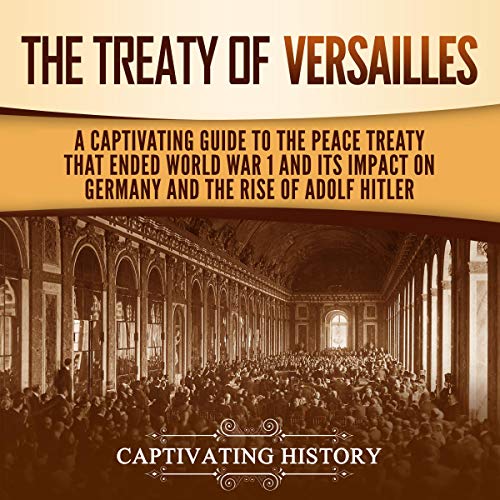
The Treaty of Versailles: A Captivating Guide to the Peace Treaty That Ended World War 1 and Its Impact on Germany and the Rise of Adolf Hitler
Summary
If you want to discover the captivating history of the Treaty of Versailles, then pay attention... The treaty that ended the First World War, also known as the “war to end all wars,” was signed at the Palace of Versailles, which had been the home of French kings until 1789 and remains one of the most beautiful structures in the world. Though the men of Versailles (and they were overwhelmingly men) had arrived in Paris to put an end to World War I, by the time the conference ended, the main goal of the diplomats and national leaders had turned into ending wars for all time. Obviously, that did not work, and as a matter of fact, the end result of the Paris Peace Conference - the Treaty of Versailles - would likely cause more wars than any of its authors could have possibly dreamed of, including World War II. In The Treaty of Versailles: A Captivating Guide to the Peace Treaty That Ended World War 1 and Its Impact on Germany and the Rise of Adolf Hitler, you will discover topics such as: Foundations What came before The truce and the run-up to Versailles The Allies The Fourteen Points The scrambled map and people of Europe The Middle East Germany The “stab-in-the-back” myth The League of Nations fiasco And much, much more... So if you want to learn more about the history of the Treaty of Versailles, scroll up and click the "add to cart" button!
©2020 Captivating History (P)2020 Captivating History

German Revolution
Summary
Discover the remarkable history of the German Revolution of 1918.... The brief history of the Weimar Republic is generally seen as an abbreviated intermission between the First and Second World Wars. It was the government, led by the Social Democratic Party, which took power, albeit with some trepidation, after Kaiser Wilhelm II abdicated the German throne. Socialists saw this as the opportunity they had been waiting for, the day when workers would be the ones in power. For the conservatives who could not accept the German defeat in World War I, however, the Weimar Republic was a feeble entity which had capitulated to Germany’s enemies. The German Revolution of 1918-1919 told the story of a bruised nation attempting to overcome its military defeat at the hands of enemies who wanted to punish Germany for starting the war. Because Germany was caught in the vise of such irreconcilable political philosophies between the left and the right, the Weimar Republic, although it was the ruling power following the German Revolution, was destined to have a doomed, short life in Germany’s tragic 20th-century history. Discover a plethora of topics such as Sacrificing for the Fatherland The German spring offensive The seeds of Revolution The Christmas crisis Rosa Luxemburg and the Spartacist uprising The end of the Revolution And much more! So if you want a concise and informative book on the German Revolution of 1918, simply scroll up and click the "Buy Nw" button for instant access!
©2020 Hourly History (P)2020 Hourly History

How to Use Stoicism to Calm Your Emotions
Summary
Do you control your emotions, or do your emotions control you? Have you ever noticed that the world is getting busier and busier? Do you sometimes feel that everyday stress and anxiety is taking over your emotional peace and true happiness? Would you like to master your mind and use it to empower your daily actions and go through life with undeniable self-confidence? If you answered yes to at least one of these questions, then keep reading.... I think you will agree with me that at the end of the day, emotions are the driving engine of our lives. They dictate our mood, our actions, our thoughts - negative or positive - and I think it is fair enough to say that for most people emotions control us. Here is just a fraction of what you’ll discover inside this book: The main principles of Stoicism philosophy - the crucial foundation that will put you on track How to reveal your true potential of positive emotions and massive action Stoic morning routine - how to prepare yourself for a perfect day Learn how to destroy stress and anxiety and push away negative emotions in your daily life How to reveal your true potential of positive emotions and massive action And much more. This guide contains actual rules and philosophies that have been used by the strongest nations on the planet - and if they believed in the power of emotions, why don’t you? You need this audiobook today!
©2020 Lucas Russo (P)2020 Lucas Russo

Age of Discovery
Summary
If you want to discover the captivating history of the Age of Discovery, then pay attention.... The Age of Discovery began in the early part of the 15th century and carried on through most of the 17th century. It is sometimes also referred to as the Age of Exploration. This was a time when the people of Europe began to travel, discover, and explore more of the world than ever before, mapping and naming the places they found. They bravely went out on the seas to learn about the world, often never sure if they would find anything at all, let alone ever return home. The explorations made during this time would impact the shape of the world going forward in many ways. Colonization, trade, and education all changed due to the expansion of the known world, as well as international relationships. In Age of Discovery: A Captivating Guide to an Era of Exploration in European History, Including Discoveries Such as Christopher Columbus’ Voyages to the Americas and Vasco da Gama’s Sea Route to India, you will discover topics such as: Prince Henry the Navigator Bartolomeu Dias Vasco da Gama Albuquerque Christopher Columbus The Latter Voyages of Christopher Columbus Amerigo Vespucci Ponce de León Diogo Lopes de Sequeira Hernán Cortés Ferdinand Magellan John Cabot The Younger Columbus The Laws of Burgos Jacques Cartier Francisco Vázquez de Coronado Francis Drake Walter Raleigh and the Two Failed Colonies The East India Trading Company The Jamestown Colony The Pilgrims of the Mayflower The Dutch East India Company Food, Agriculture, and Livestock Disease, Slavery, and Religion And much, much more! So if you want to learn more about the Age of Discovery, scroll up and buy now!
©2020 Captivating History (P)2020 Captivating History

Elizabeth Taylor
Summary
Discover the remarkable life of Elizabeth Taylor.... Elizabeth Taylor was born to become a legend. By the time she was a young teenager, she was already making news and attracting attention. Taylor would go onto star in movies such as A Place in the Sun, Butterfield 8, Who's Afraid of Virginia Woolf?, and Cleopatra, where she played opposite Richard Burton. Her affair with Burton caused a worldwide scandal, and the movie almost ruined 20th Century Fox. Taylor and Burton were married and divorced twice, with the world watching their every scandalous move. In her fifties, when Taylor was no longer in demand for leading lady roles, she developed her own brand of perfumes and jewelry. These were so successful that she made more money from her brands than from her movies. She also became the voice for AIDS when everyone else in Hollywood ignored the subject. Her grandchildren have now taken over the Elizabeth Taylor AIDS Foundation and continue her work long after her death. Elizabeth Taylor, the “most beautiful woman in the world”, will continue to affect people for years to come. Discover a plethora of topics such as: Born Beautiful Becoming Mrs. Hilton Cleopatra and Eddie Fisher On the Campaign Trail The Elizabeth Taylor AIDS Foundation Late Life and Death And much more! So, if you want a concise and informative book on Elizabeth Taylor, simply scroll up and click the "buy now" button for instant access!
©2020 Hourly History (P)2020 Hourly History

Wounded Knee Massacre
Summary
Discover the tragic history of the Wounded Knee Massacre. The events which took place on a bitterly cold morning near Wounded Knee Creek on December 29, 1890, represent the last acts in the series of bloody conflicts that were carried out between White settlers and Native Americans over a period of more than 200 years. These deaths of several hundred people of the Lakota tribe at the hands of soldiers from the US 7th Cavalry have also become symbolic of the often violent subjugation of Native American culture. This event was originally known in the United States as the Battle of Wounded Knee and was celebrated as a resounding victory for US troops over a dangerous band of Native American warriors. More than 20 soldiers who participated were awarded the Medal of Honor, the highest US award for valor in combat. It only later became clear that most of the dead Lakota were unarmed women and children and that this group of Native American people was not on the warpath, but attempting to flee to safety on a reservation. Wounded Knee was not just another battle of the Indian Wars. It marked the moment when hopes for the preservation of a unique Native American way of life finally died. Before Wounded Knee, there were frequent and often violent conflicts between settlers and Native Americans. After Wounded Knee, most Native Americans were confined to reservations where they were increasingly overwhelmed by feelings of despair and hopelessness. Wounded Knee is important in itself as an example of the massacre of helpless people by a well-armed adversary from an entirely different culture, but also in the wider context as the final act in the story of conflict between Whites and Native Americans. Whether you choose to call it a battle, a massacre, or simply a tragedy, this is the story of what really happened at Wounded Knee Creek in December 1890.
©2020 Hourly History (P)2020 Hourly History

Cultural Revolution
Summary
If you want to discover the captivating history of the Cultural Revolution, then pay attention... Two captivating manuscripts in this audiobook: The Cultural Revolution: A Captivating Guide to a Decade-Long Upheaval in China Unleashed by Mao Zedong to Preserve Chinese Communism Mao Zedong: A Captivating Guide to the Life of a Chairman of the Communist Party of China, the Cultural Revolution and the Political Theory of Maoism Some of the topics covered in part one of this audiobook include: Mao Zedong’s Early Life, Rise to Power, and the Government Upheaval That Changed China During the First Half of the 20th Century The Suspicion Behind the United Face The Five-Year Plan, the Great Leap Forward, and the Events Leading to the Cultural Revolution Fighting the Capitalism of the West The Introduction of Revolution The Red Guards July 20th Incident Border Clashes with the Communist Soviets Lin Biao - the Successor and Opponent Health Issues and Slipping Grip on the Revolution The 10th Congress and the Shifting of Power Mass Killings in China and Devastation in Northern China End of the Cultural Revolution Lasting Effects And much, much more! Some of the topics covered in part two of this audiobook include: Early Life Political Awakenings Beijing May Fourth and the New Culture Movement The Communist Party of China’s Growing Pains The Northern Expedition Communists at Large The Long March The People’s Republic of China The Great Leap Forward The Cultural Revolution What Did Maoism Stand For? And much more! So, if you want to learn more about the Cultural Revolution and Mao Zedong, scroll up and click the "buy now" button!
©2020 Captivating History (P)2020 Captivating History

Agatha Christie: A Life from Beginning to End
Summary
Discover the remarkable life of Agatha Christie.... Free Bonus Inside! Agatha Christie, born in upper-middle-class British society during the late Victorian era, turned into one of the most prolific and popular mystery writers of all time. Her novels have been translated into 44 languages and have sold over two billion copies worldwide. Her mysteries continue to sell as new generations of readers discover the delights of her main characters, Hercule Poirot and Miss Marple. In addition, Christie’s plays have been a tremendous success, with The Mousetrap running in London for the past 70 years. This is the story of the best-selling fiction writer of all time - Dame Agatha Christie. Discover a plethora of topics such as: An Enchanted Childhood Agatha Meets Archie Christie The Loss of Her Mother and Husband Christie’s Mysterious Disappearance Murder Most Foul: Enter Miss Marple Final Years and Death And much more! So if you want a concise and informative book on Agatha Christie, simply biu now for instant access!
©2020 Hourly History (P)2020 Hourly History

Ancient Anatolia
Summary
If you want to discover the captivating history of ancient Anatolia, then pay attention.... What sparks curiosity about ancient Anatolia, which makes up most of modern-day Turkey, in the minds of history lovers is the diversity of its peoples throughout its territories and time. This audiobook seeks to present the most current view on the events that unfolded through the centuries of the Bronze and Iron Ages of Anatolia. The listener can follow the rise of some of the most famous empires in the world, as well as learn about the circumstances that led to their fall. From early settlements of nomadic tribes to the creation of vast empires, Anatolia changed its face numerous times throughout history. Not just territories and kingdoms changed, but the people inhabiting it also did so as well, in their language, culture, and religion. Even though they were faced with a lack of evidence for certain periods of ancient Anatolia, or for certain peoples, historians seek to accurately paint the picture of the lives in all the various kingdoms of Anatolia. This audiobook follows the Hittite Empire in its rise and fall. It discusses the Arameans and the influence of their culture on the civilized world, as well as the influence of the Luwians and their dispersion throughout Anatolia. Even if they were never able to organize a united Luwian Empire, they changed all the kingdoms they came in contact with. The effects of this ancient civilization can still be felt today as certain dialects of the Luwian language still exist in Anatolia. If you want to learn more about ancient Anatolia, buy this book today!
©2019 Captivating History (P)2020 Captivating History

Hannibal Barca: A Captivating Guide to the Carthaginian General Who Fought in the Second Punic War Between Carthage and Ancient Rome
Summary
If you want to discover the captivating life of Hannibal Barca, then pay attention... One of the names most synonymous with brilliant military strategy is Hannibal. He was the legendary Carthaginian general who marched elephants over the snowy Alps and took on Rome, the growing power in Europe at the time. He outsmarted the best strategists that Rome had to offer and twice sat in front of the gates of Rome with his army. There was never any doubt that Hannibal would serve his country in the military, but no one could have predicted just how well he would serve Carthage. Even centuries later, Romans used the phrase “Hannibal’s at the gates!” as a way of indicating misfortune or fear. Even natural disasters were compared to him. His actions would go on to haunt the Romans for centuries. Because of the threat he had been to them, the Roman Republic was forced to learn how to outsmart their opponents and not just beat them. The actions of Hannibal helped to shape and form Rome into the military power that it became because they realized early on that they were not as safe as they had thought they were. In Hannibal Barca: A Captivating Guide to the Carthaginian General Who Fought in the Second Punic War Between Carthage and Ancient Rome, you will discover topics such as: Rome Versus Carthage - The First Punic War Born into an Uncertain World The Element of Surprise - The Beginning of a Legend Panic in Rome and the Subsequent Raiding of Roman Territory The Rivalry Between Hannibal and Fabius Defeating Hannibal Using Politics to Improve Carthage and a Final Betrayal Cat and Mouse with Rome - Roles Reversed Speculation on Hannibal’s End and the End of Carthage in the Third Punic War And much, much more... So if you want to learn more about Hannibal Barca, scroll up and click the "Add to Cart" button!
©2019 Captivating History (P)2019 Captivating History