Charles River Editors has 541 audiobooks on Listento.it, narrated by 125 narrators, with an average listener rating of 3.8★ across 258 ratings. The most-rated is The Gift of Therapy.

The Maurya Empire
Summary
During the last centuries of the first millennium BCE, most of the Mediterranean basin and the Near East were either directly or indirectly under the influence of Hellenism. The Greeks spread their ideas to Egypt, Mesopotamia, and Persia and attempted to unify all of the peoples of those regions under one government. Although some of the Hellenistic kingdoms proved to be powerful in their own rights -- especially Ptolemaic Egypt and the Seleucid Empire, which encompassed all of Mesopotamia, most of the Levant, and much of Persia during its height -- no single kingdom ever proved to be dominant. The Hellenic kingdoms battled each other for supremacy and even attempted to claim new lands, especially to the east, past the Indus River in lands that the Greeks referred to generally as India. But as the Hellenistic Greeks turned their eyes to the riches of India, a dynasty came to power that put most of the Indian subcontinent under the rule of one king.
©2017 Charles River Editors (P)2017 Charles River Editors

Armenian Myths and Legends
Summary
Armenia is considered to be one of the oldest cradles of civilization, with the area of historical Armenia roughly extending to the area stretching from the Euphrates River in the west, the region of Artsakh, parts of Caucasian Albania to the east, parts of the modern state of Georgia to the north, and its southern boundary abutting the northern tip of Mesopotamia. Armenia is a landlocked mountainous plateau that rises to an average of over 6,000 feet above sea level, and for this reason, the territory was commonly referred to as the Armenian Highlands. In these highlands, Armenian culture, as well as its language, started to develop. Rich cultural material, mythological and legendary tales, toponyms and names, as well as historical sources serve as evidence the Armenian Highlands have been inhabited by Armenians since the dawn of time. Like many other people all over the world, Armenian people also created their own mythology and heroes. The first pantheon of the Armenian pagan gods had gone through its formation parallel to the development of the Armenian people as a consequence of the religious beliefs the people bore. Before being the first kingdom to convert to and accept Christianity as its religion in the year of AD 301, Armenians were pagan and believed in a multitude of gods and goddesses. These were attributed with many natural elements. The main sources that have conveyed the Armenian pagan myths and legends to the following generations are the Armenian historians of the fourth to seventh centuries, such as Agathangelos, Faustus the Byzantine, Movses Khorenatsi, and Sebeos. Another prime source containing many clues that helps us grasp and comprehend these myths and legends is the Armenian national heroic epic Daredevils of Sassoun. Armenian Myths and Legends: The History of the Mythology and Folk Tales from Armenia looks at the stories that came from Armenia in ancient times, including their influences from other cultures. You will learn about Armenian mythology like never before.
©2018 Charles River Editors (P)2018 Charles River Editors
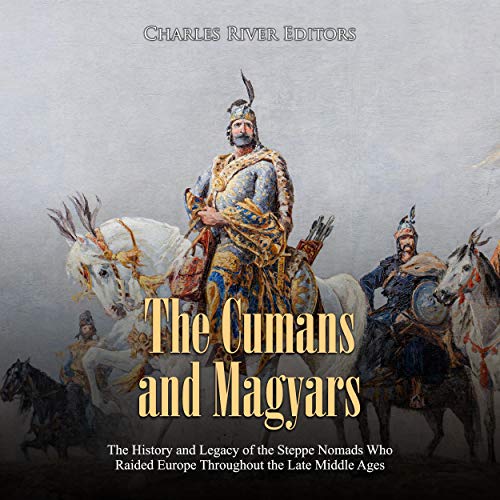
The Cumans and Magyars
Summary
Of all the steppe peoples in the medieval period, perhaps none were more important to European history than the Magyars. Like the Huns and Avars before them and the Cumans and Mongols after them, the Magyars burst into Europe as a destructive, unstoppable horde, taking whatever they wanted and leaving a steady stream of misery in their wake. They used much of the same tactics as the other steppe peoples and lived a similar, nomadic lifestyle. The Magyars also had many early cultural affinities with other steppe peoples, following a similar religion and ideas of kingship and nobility, among other things. That said, as similar as the Magyars may have been to other steppe nomads before and after them, they were noticeably different in one way: The Magyars settled down and became a part of Europe and Western Civilization in the Middle Ages. The Magyars exploded onto the European cultural scene in the late ninth century as foreign marauders, but they made alliances with many important kingdoms in less than a century and established their own dynasty in the area, roughly equivalent to the modern nation-state of Hungary. After establishing themselves as a legitimate dynasty among their European peers, the Magyars formed a sort of cultural bridge between the Roman Catholic kingdoms of Western Europe and the Orthodox Christian kingdoms of Eastern Europe. Ultimately, the Magyars chose the Roman Catholic Church, thereby becoming a part of the West and tying their fate to it for the remainder of the Middle Ages.
©2020 Charles River Editors (P)2020 Charles River Editors

Legendary Philosophers: The Life and Philosophy of Friedrich Nietzsche
Summary
"There are no facts, only interpretations." (Nietzsche) A lot of ink has been spilled covering the lives of history's most influential figures, but how much of the forest is lost for the trees? Among all the knowledge and pursuits handed down by our ancestors, few were as important as philosophy, which literally taught people how to think and became directly responsible for ideas like reason and empiricism. Men like Socrates, Plato, and Aristotle formed the backbone of Western philosophy, and subsequent philosophers like Marcus Aurelius and Thomas Aquinas expounded on previous philosophy. In Charles River Editors' Legendary Philosophers series, listeners can get up to speed on the lives of the most important philosophers in history in the time it takes to finish a commute, while learning interesting facts long forgotten or never known. It might be fair to say that everyone's thinking has been influenced at one point or another by Friedrich Wilhelm Nietzsche, or at least someone who was influenced in turn by Nietzsche. Nietzsche (1844-1900) was one of the most influential men of the 19th century, a German philosopher, poet, and composer who wrote at length about everything from religion to science. In addition to the importance of his work, he was a deft writer and polemic, ensuring his continuing popularity among readers. Nietzsche's influence remains substantial within and beyond philosophy today, most notably in existentialism, nihilism, and postmodernism, all thriving movements in the 21st century.
©2012 Charles River Editors (P)2015 Charles River Editors

Thor
Summary
"Across the rainbow bridge of Asgard, Where the Booming Heavens Roar, You'll behold in breathless wonder, the God of Thunder, Mighty Thor!" (Theme song from the television show Mighty Thor [1966]) "In swelling rage | then rose up Thor, - Seldom he sits | when he such things hears, - And the oaths were broken, | the words and bonds, The mighty pledges | between them made." (Völuspá Line #26 from the "Poetic Edda") A hammer no mortal can lift. A flame-haired, fiery storm god. A comic book alien-hero-god who defends humanity. The swastika. Even the name "Thursday" ("Thor's Day"). Despite the virtual disappearance of the indigenous Norse religion and mythology several centuries ago, modern society still regularly encounters the storm god Thor, who continues to be brought back to life in the form of literature and was recently the protagonist in a big-budget Hollywood movie. What is it about this god, out of the hundreds (if not thousands) of deities that were consigned to the dustbin of history by the world's major religions, that so captures people's imaginations today? A better understanding of Thor's appeal can be found in just about every aspect of the history and evolution of the figure over the centuries, including the origins of the god, the evocative imagery used to describe him, and even the parallels between Thor and similar gods and heroes.
©2012 Charles River Editors (P)2015 Charles River Editors

The Amber Road
Summary
“Pytheas says that the Gutones, a people of Germany, inhabit the shores of an estuary of the Ocean called Mentonomon, their territory extending a distance of six thousand stadia; that, at one day's sail from this territory, is the Isle of Abalus, upon the shores of which, amber is thrown up by the waves in spring, it being an excretion of the sea in a concrete form; as, also, that the inhabitants use this amber by way of fuel, and sell it to their neighbors, the Teutones...” (Pliny the Elder)
The story of the Silk Road has been a popular topic among tourists, academics, economists, state parties, and daydreaming children for many centuries. In many ways the Silk Road can be seen everywhere, and it has existed for as long as people have traveled across Eurasia. Its impact is widely felt among the diverse peoples that live on the continent, through the unique regional art and architectural styles, as well as in countless films, books, academic studies, and organized tours devoted to the ancient trade routes.
At the same time, however, the Silk Road is an entirely abstract invention, first coined by the 19th century German geographer Ferdinand von Richthofen. There has never existed a single route - let alone a road - that was used to transfer goods, nor was silk the primary commodity traded across Eurasia. Instead, the Silk Road is more a multi-layered narrative about the rise and fall of nomadic confederations and sedentary societies, the consolidation and dissolution of kingdoms and empires, the exchange of commodities and fine crafts, and the transfer and mixture of ideas, religions, technology, science, art, architecture, myths, and legends. It is a story that is relevant for the present-day countries through which this exchange once took place, as they lay claim to the artifacts, heritage sites, and symbolic meaning of the Silk Road for political and economic purposes and to build their national identity.
In fact, international trade in the ancient world was a more intricate and far-reaching system than many have been led to believe. The Silk Road and the Incense Trade Route have been heavily investigated in recent decades, but the Amber Road trade network dominating northern Europe has been given far less attention. Amber, the hardened sap of prehistoric trees, has washed up on Baltic shores for generations, and though it had little value to the locals beyond religious symbolism and aesthetic beauty, they learned that foreign civilizations would pay massive sums for the beautiful substance.
Though written sources are scattered and tend to come and go depending on the civilization involved, much has been written by ancient authors, particularly of Greek and Roman origins. More importantly, archeologists have traced the spread of amber through the discovery of pieces with specific chemical construction, linking it back to the Baltic region. Once thought to have mainly been exported to Rome, Baltic amber has also been found in Mycenaean Greece, Egypt and Syria, though perhaps not surprisingly, it was Roman demand that formed the height of the amber exchange.
Perhaps even more interesting than the movement of the amber is regarding shifting trade operations from government controlled systems to private merchant enterprises to monopolies of guilds and orders, a return to government control, and finally, the selling of the trade to individual countries. It is a fascinating microcosm of changing political and governmental landscapes through millennia of change and development in northern Europe and the wider ancient Mediterranean world.
The Amber Road: The History and Legacy of the Ancient Trade Network that Moved Amber across Europe looks at the development of this crucial trade, and its impact on antiquity.
©2019 Charles River Editors (P)2019 Charles River Editors

American Legends: The Life of Judy Garland
Summary
"I was born at the age of 12 on a Metro-Goldwyn-Mayer lot." - Judy Garland A lot of ink has been spilled covering the lives of history's most influential figures, but how much of the forest is lost for the trees? In Charles River Editors' American Legends series, listeners can get caught up to speed on the lives of America's most important men and women in the time it takes to finish a commute, while learning interesting facts long forgotten or never known. In many ways, Judy Garland's rise to fame seems almost predestined. Not only was she a national sensation at a young age, but her parents and sisters were all vaudeville entertainers. On top of that, Garland's parents owned and operated a movie theater, making it all the easier to draw the conclusion that singing and acting were simply professions which she was born into by virtue of her pedigree. Judy's early childhood quickly demonstrated that she had a gifted voice that developed well beyond its years and seemingly did not require any formal training in order to achieve success; her first performance before a public audience came when she was still a toddler, and she would continue to act up until her death, never pausing for more than a few months at a time. That Garland was able to secure starring roles almost immediately after signing a contract with MGM in 1935 only corroborates the belief that Garland was practically born with the ability to succeed in show business and the motion picture industry.
©2013 Charles River Editors (P)2015 Beacon Audiobooks

The Soviet Invasion of Hungary in 1956
Summary
For 30 years, much of the West looked on with disdain as the Bolsheviks took power in Russia and created and consolidated the Soviet Union. As bad as Vladimir Lenin seemed in the early 20th century, Joseph Stalin was so much worse that Churchill later remarked of Lenin, “Their worst misfortune was his birth...their next worst his death”. Before World War II, Stalin consolidated his position by frequently purging party leaders (most famously Leon Trotsky) and Red Army leaders, executing hundreds of thousands of people at the least. And in one of history’s greatest textbook examples of the idea that the enemy of my enemy is my friend, Stalin’s Soviet Union allied with Britain and the United States to defeat Hitler in Europe during World War II. As it turned out, however, the Soviets would not cede any of the territory the Red Army took while pushing the Wehrmacht back to Berlin in the latter stages of World War II, ensuring that the Iron Curtain would envelop much of Central and Eastern Europe. In almost no time at all, most of these countries were transformed into authoritarian, communist, one-party states, and opponents were exiled or jailed. In 1955, Moscow had brought together all the satellites as part of the Warsaw Pact, a collective security organization to challenge the North Atlantic Treaty Organization (NATO), which had been founded in 1949 by the United States and Western European allies. Nonetheless, the mid-1950's were tumultuous for the Soviet Bloc. Several countries saw Stalin’s death and the apparent change of direction, even the softening of policy under Khrushchev, as an opportunity to pursue a reformist path. In East Germany, Poland, and Hungary, demonstrations against the communist regimes induced uncertainty, and Hungarian leaders attempted to incorporate the protestors and orientate themselves towards the West, leading to a notorious Soviet invasion. Only occasionally did the peoples of the so-called Eastern Bloc attempt to break free from the status quo, or at least register their dissatisfaction. These mass demonstrations and uprisings act as markers of the Cold War, including 1953 in East Berlin, 1968 in Czechoslovakia, 1980-81 in Poland, and, of course, 1989 in East Germany, Czechoslovakia, and Romania. The fall of the Berlin Wall is likely the most famous, but the uprising with the greatest impact on the bulk of the Cold War took place in Hungary in 1956, when protestors took to the streets to demand freedom from tyranny and a greater say in their own destiny. When the Hungarians rose up against the status quo in October 1956, they were met with a brutal response from Moscow. The history of Hungary is one of a country that experienced almost constant expansion and contraction, along with waves of autonomy and domination. It is this sense of history that played such a dominant role in 1956 and why the suppression of the Hungarian Revolution has such a searing place in the national consciousness. Above all, 1956 brought about a sense of helplessness that Hungary had little chance to tread a path of national self-determination, as the threat of Soviet military intervention hung over the country. Of course, that was the Soviets’ intention all along. By crushing the Hungarian Uprising, the Soviets dampened the hopes of the people of Central and Eastern Europe that they might be able to pursue a more independent-minded path. The one exception to this rule would be Tito’s Yugoslavia. The Soviet Invasion of Hungary in 1956: The History and Legacy of the Hungarian Uprising and the Military Operations That Put It Down looks at the events that brought about the most famous rebellion against Soviet authority during the Cold War; you will learn about the Soviet invasion of Hungary like never before.
Public Domain (P)2020 Charles River Editors

The Gulags
Summary
One of the most idiosyncratic horrors of Soviet Russia was the Gulag system, an extensive network of forced labor and concentration camps. Part of the rationale behind this system was that it could serve as slave labor in the drive for industrialization while also serving as a form of punishment. The name Gulag is in fact an acronym, approximating to “Main Administration of Camps” (in Russian: Glavnoe Upravlenie Lagerei) and operated by the Soviet Union’s Ministry of the Interior. The Gulag consisted of internment camps, forced labor camps, psychiatric hospital facilities, and special laboratories, and its prisoners were known as zeks. Such was the closed and secretive nature of the Soviet state that to this day, knowledge of the Gulag system comes mainly from Western studies, firsthand accounts by prisoners such as Aleksandr Solzhenitsyn, and some local studies after the fall of communism. The most recognizable version of the Gulag, a term that was never pluralized in Russia itself, existed from the 1930s to 1950s, a period in which a huge network of camps and prisons was established across the vast Soviet federation. Prisoners were often used as forced labor, made to do physically arduous and soul-destroying tasks. Some workers helped to build large infrastructure projects, and indeed, the system was partly rationalized in terms of economics. By the early 1960s, Gulags were synonymous with various forms of punishments, including house arrest, imprisonment in isolated places, or confinement to a mental hospital where a prisoner would be declared insane or diagnosed with a “political” form of psychosis. In its later years, the Gulags held a particular place in the public’s imagination, both within the USSR and in the outside world. They could mean exile, brutal punishment, or simply being banished to Siberia. Though it’s often forgotten today, in many respects, the Gulags represented a continuation (albeit a more far-reaching version) of the kind of punishment meted out during the Russian Empire under the Romanov dynasty, which was overthrown in 1917. Therefore, it is necessary to examine the system in the context of the broader history of Russia and its empire, even as the system of repression, imprisonment, and punishment persisted for decades in the Soviet Union and has been primarily aligned with the rule of one leader: Josef Stalin. The USSR collapsed in December 1991, and it can be argued that the labor camps were not only integral to the very existence of the Soviet Union, but also a damning indictment of the Soviets’ failed experiment in communist totalitarianism. The Gulags: The History and Legacy of the Notorious Soviet Labor Camps examines the rise of the labor camps, how they were institutionalized by Soviet leaders, and what life was like for the prisoners.
©2018 Charles River Editors (P)2019 Charles River Editors

John Dee
Summary
“Who does not understand should either learn, or be silent.” (John Dee) With the golden glow of the candlelight kissing his cheeks, he hovered over a spirit mirror - a flat, exquisitely lustrous “shew-stone” fashioned out of raven-black obsidian. Gazing intently upon his reflection in the dark volcanic glass, he chanted in hushed tones as he ran his fingers across the engravings on the oat-colored wax wheel next to him, the Sigilla iEmeth, which featured a septogram and runic carvings and symbols in minuscule print. Contrary to what one might expect, it was not a phantom, hobgoblin, or demon that he sought, but rather, the seraphic voice, and perhaps even the face of an angel - the one bridge between mankind and their Creator, one who holds the key to all of life's unanswerable questions. Was this man delusional? Perhaps so, but perhaps, not. But there was no question among those on hand that this was not an ignorant, philistine, unlettered buffoon of a man who readily boarded the train of groundless superstition. Far from it, this was a man who held not only a master's degree, but a doctorate, and his simultaneously stimulating and mesmerizing lectures drew crowds of royals and nobles from near and far. This was a man who was well-versed in a host of academic fields, and he would go on to serve as one of his queen's foremost personal advisers. He was also a prolific author whose revolutionary ideas helped chart the path for the burgeoning British Empire. The man in question is none other than John Dee, one of the greatest scientific minds of his time, but also one of the most controversial. He was a learned man in fields as varied as mathematics and astronomy, centuries before they became formalized fields of study, but he is better remembered for performing magic and alchemy. Instead of astronomy, he became renowned across England for astrology, and he was one of the country’s most notorious occult writers during his life. Given the variety that the Elizabethan Era had to offer, it should come as little surprise that some eccentric characters with seemingly unique skills pushed to the forefront and became lauded members of society. Over the course of her long reign, Queen Elizabeth I became one of England’s most famous and influential rulers, and it was an age when the arts, commerce, and trade flourished. It was the epoch of gallantry and great, enduring literature. It was also an age of wars and military conflicts in which men were the primary drivers and women often were pawns. John Dee himself has been credited with coming up with the name “British Empire” in the first place. As all of this suggests, to say that John Dee was a storied man would be a grave understatement, to say the least. His multifaceted reputation preceded him, and his name became synonymous with both brilliance and disconcerting eccentricity. By all means, he certainly looked the part - the occultist towered over his peers, his wiry frame cloaked in a charcoal-black artist's gown with a ruffled white collar, his veined hands peeking out of his flared sleeves. He bore a pasty, pallid complexion, which seemed almost ghostly, paired with a magnificent beard that was “as white as milk”. Chilling rumors about his immeasurable magical abilities have kept his name alive for centuries. Legend has it that this was a man who singlehandedly cast a crippling curse on the Spanish Armada as the fleet sailed toward England, conjuring up the merciless storms and violent waves that threatened to swallow the ill-starred convoy whole, and left them with no choice but to turn back. This was a man who was once branded “the greatest rogue in the neighborhood of London".
©2019 Charles River Editors (P)2019 Charles River Editors

Catholic Legends: The Life and Legacy of St. Thomas Aquinas
Summary
It would be hard to overstate the influence that St. Thomas Aquinas (1225-1274) has had on both the Catholic world and the West as a whole over the last 750 years. Even in secular circles, Aquinas is known as one of the most important medieval philosophers, and in many respects a harbinger of the Renaissance that began to flourish across Europe in the centuries that followed his life. His groundbreaking work, Summa Theologica, remains one of the most influential philosophical texts in history, earning him a place in the pantheon alongside Plato, Aristotle, and Socrates. Aquinas had just as great an influence on Christianity as well. His philosophical works forged and established natural theology, squaring Catholicism with reason and logic, the ideals and aspects of modern thought that really took hold during the Renaissance. With his work on logic, theology, and metaphysics, as one of the Church's Doctors, Thomas Aquinas remains the Catholic Church's greatest theologian and philosopher, and he is still held out by the Church as the role model for those studying to become a Catholic priest. Catholic Legends: The Life and Legacy of St. Thomas Aquinas details the remarkable life he lived and analyzes his writings, explaining how strong and enduring his legacy has become.
©2012 Charles River Editors (P)2015 Charles River Editors

The Iranian Revolutionary Guards
Summary
In early November 2016, Salar Abnoush, a leader in the Iranian Revolutionary Guard Corps (IRGC), stated that the IRGC "will be in the US and Europe very soon." This quote came just before the US presidential election, a time when President Barack Obama was winding down his presidency and American society was busy reflecting on his past actions over the eight years of his presidency. Of those actions that incoming President Donald Trump has decided to focus on, "tearing up" the Joint Comprehensive Plan of Action (also more commonly known as the Iran Nuclear Deal) was near the top of the list. The crux of the deal focuses on Iran's agreement to roll back uranium stockpiles and enrichment capabilities in exchange for the ending of nuclear-related sanctions against Iran. Due to the IRGC's current involvement in the Iranian economy, they stand to gain from the ending of the sanctions. Possible threats to the deal by the incoming Trump Administration are of concern in Iran, and the threat of the IRGC spreading in western countries is a concern as well. The impact of the changing of terms to the Iran Nuclear Deal is just one concern among many of members of the IRGC. The multi-party conflict of the Syrian Civil War has pulled Iran deeper into this global conflict, as the numbers of refugees and internally displaced people rise. Through it all, the Iranian Revolutionary Guard Corps has held a position of power and prestige in Iranian society and has inspired both revolution and concern around the world. The IRGC is notable for its involvement in conflicts around the Middle East, particularly in supporting Shi'a groups through military training and finance, as well as backup support on the battlefield. This is not to say the IRGC enters into conflicts for the sake of being involved, but rather, they see these particular situations as serving the interests of Iran and furthering their brand of Shi'ism, a sect of Islam. The IRGC sees itself as a protector of Islam, Iran's theocracy, and the principles of the 1979 Iranian Revolution, so its involvement is always framed in terms of benefits to the overall goals of promoting revolutionary ideals. As analyst Afshon Ostovar puts it, "The IRGC is a multifaceted organization with reach into many different areas. It is a security service, an intelligence operation, a social and cultural force, and a complex industrial economic conglomerate." The IRGC operates in a very similar manner to other Islamist paramilitary organizations, such as Hezbollah, Hamas, the Muslim Brotherhood, and - their current enemies on the battlefield - the Islamic State of Iraq and the Levant (ISIL) and Jabhat Al-Nusra. These Islamist groups' power and influence comes from their control over the societies in which they operate and whether or not they have influential allies. The main difference for the IRGC, however, is the support of Iranian leadership in carrying out their main mission of maintaining and exporting the revolution. In essence, the IRGC has rooted itself in Iranian society and spread its influence through association with the society's most integral components - the education system, businesses, civil organizations, and religion - all at the request and blessing of the Supreme Leader of Iran. This is a similar model ISIL and Jabhat Al-Nusra are attempting to carry out in Syria and Iraq, and the one that Hamas and Hezbollah currently carry out in Lebanon and the Palestinian territories. The IRGC is also very much involved in Iran's economy and has a stake in its nuclear ambitions.
©2017 Charles River Editors (P)2017 Charles River Editors

The Master of Suspense
Summary
"I am a typed director. If I made Cinderella, the audience would immediately be looking for a body in the coach." - Alfred Hitchcock, 1956 In the opening pages of his seminal book-length study of Alfred Hitchcock, Hitchcock's Films (1965), Robin Wood famously asked, "Why Should We Take Hitchcock Seriously?" Wood then proceeded to offer a detailed examination of Hitchcock's career to that point, arguing that the Master of Suspense belonged among the ranks of the preeminent directors in Hollywood, and that his films were among the most important in American culture. When Wood was asking that question, he wasn't asking it rhetorically and was arguing for Hitchcock's relevance, which seems strange today because Hitchcock is now a Hollywood icon. No one would even think of asking that same question today, as just about every American is familiar with Hitchcock's work in some way or another. Hitchcock is regarded as perhaps the most famous and influential director in history, so Wood's question back in 1965 at least demonstrates the evolution of Hitchcock's reputation and the critical reception of his career. Indeed, as revered as Hitchcock is today, it is telling that he was never awarded an Academy Award during his career (though he was given an honorary Oscar after his retirement.) Vertigo (1958), for example, is now considered one of the landmark films of the classical Hollywood cinema, but it was both a box office and a critical flop upon its release. Other Hitchcock films, such as Psycho (1960) and North by Northwest (1959), performed well at the box office but were not viewed as high art.
©2012 Charles River Editors (P)2015 Charles River Editors

The Cumans
Summary
Let us begin this narration, brethren, from the old times of Vladimir to this present time of Igor, who, strengthened his mind with courage, who quickened his heart with valor and, thus imbued with martial spirit, led his valiant regiments against the Kuman land in defense of the Russian land.” (The Tale of Igor’s Campaign) Before the Mongols rode across the steppes of Asia and Eastern Europe, the Cumans were a major military and cultural force that monarchs from China to Hungary and from Russia to the Byzantine Empire faced, often losing armies and cities in the process. The Cumans were a tribe of Turkic nomads who rode the steppes looking for plunder and riches, but they rarely stayed long after they got what they wanted. From the late 9th century until the arrival of the Mongols in 1223, there was virtually nothing that could be done to stop the Cumans. Old Russian chronicles, Byzantine texts, Western European chronicles, and travel diaries of Islamic scholars all reveal that the Cumans were a threat to any kingdom in their path. Some kingdoms chose to fight the Cumans and often suffered heavy destruction, while others believed buying them off was the more reasonable course of action. The latter course often brought them into intimate contact with the most powerful kingdoms of medieval Eastern Europe before the Cumans were eventually replaced by the Mongols, with the remaining Cumans dispersing and integrating into various European and central Asian kingdoms in the 13th century. Many Cumans joined the Mongol Golden Horde and later became Muslims, while some helped found dynasties in Bulgaria, Hungary, and Romania. The Cumans came from somewhat mysterious origins before they became the western vanguard of a massive nomadic horde that grew in ferocity and effectiveness as the centuries passed, but they were far more than mindless barbarians interested in violence alone. Although violence did play a major role in early Cuman culture, sources reveal they were also interested in diplomacy and eventually integrated with their sedentary neighbors. Archaeological discoveries further indicate that their culture was unique, complete with mythology and some art, but in the end, the Cumans disappeared as quickly as they appeared on the historical scene, much like other nomadic peoples before and after them. The Cumans: The History of the Medieval Turkic Nomads Who Fought the Mongols and Rus’ in Eastern Europe examines how the Cumans became a major fighting force in the region, and the influence they had. You will learn about the Cumans.
©2020 Charles River Editors (P)2020 Charles River Editors

Lawrence of Arabia
Summary
He was recognized by many as a curious scholar and archaeologist, brilliant linguist, British soldier, extraordinary adventurer, and avid writer, though he called himself an "ordinary man". He was a gifted translator, a shrewd diplomat, a brilliant tactician, and an instinctive leader. T.E. Lawrence, more popularly known as Lawrence of Arabia, was a seminal figure in the shaping and reshaping of the politics of Arabia in the early 20th century, serving as an expert in Arab affairs in the British military and playing a key role in the Great Arab Revolt of 1916-1918. World War I, also known as the Great War of 1914-1918, was one of the deadliest conflicts in human history, leading to the deaths of millions of soldiers and civilians, and it was a war that produced too many casualties and too few heroes. However, after the war was over, the world was told of the blonde-haired, blue-eyed British officer named Thomas Edward Lawrence, and his experiences in Arabia during the fighting. Pictures of Lawrence in a flowing white robe of Arabia's Bedouin tribes were distributed, and Lawrence's autobiography, Seven Pillars of Wisdom, further catapulted his fame and sensationalized his public image. Lawrence's story served to boost the spirits of many who were struggling to recover after the tragedy of the war. It is telling of just how remarkable the tale is that the world’s fascination with Lawrence of Arabia has endured today. Articles, books, films, and documentaries about Lawrence and his exploits are continuously released on an annual basis. Historian Phillip Knightley once commented, "Along with Winston Churchill, [T.E. Lawrence] remains perhaps the best-known Englishman in the world." Decades since the end of the war, and with a completely changed Middle Eastern geopolitical landscape, Lawrence of Arabia and his legacy are still remembered and referenced as politically, militarily, and socially pertinent. However, Lawrence was by no means everything he claimed to be. Like many great men touched by fame and celebrity, he exaggerated some details, underplayed others, and strove to maintain an image of himself that he had created in his own mind. Thus, Lawrence was and still is a very controversial figure. He was the first in the 900 year history of the British monarchy to refuse a knighthood, and the film Lawrence of Arabia, starting Peter O’Toole as Lawrence and widely lauded as a masterpiece, was banned in many Arab and Middle Eastern countries, including Jordan and Turkey. Turkey especially has long vilified Lawrence, questioning the veracity of many of his accounts. Just recently, in October 2014, Turkish President Recep Tayyip Erdogan went so far as to declare T.E. Lawrence a greater enemy than the radical terrorist organization that is operating in Iraq and Syria, the Islamic State (IS). In a furious anti-Western diatribe, Erdogan described Lawrence as an "English spy disguised as an Arab", and he warned of the threat posed by modern-day Lawrences in Turkey "disguised as journalists, religious men, writers, and terrorists" who are allegedly aiming to destabilize the country and region.
©2016 Charles River Editors (P)2016 Charles River Editors

The Peshtigo Fire of 1871
Summary
"Why is this story not known? You see endless stories about Johnstown. What happened at Peshtigo makes Johnstown look like a birdbath.... The air burned hotter than a crematorium and the fire traveled at 90 mph. I read an account of a Civil War veteran who had been through some of the worst battles of the war. He described the sound - the roar - during the fire as 100 times greater than any artillery bombardment." - Bill Lutz, co-author of Firestorm at Peshtigo In arguably the most famous fire in American history, a blaze in the southwestern section of Chicago began to burn out of control on the night of October 8, 1871. It had taken about 40 years for Chicago to grow from a small settlement of about 300 people into a thriving metropolis with a population of 300,000. But in just two days in 1871, much of that progress was burned to the ground. Due to the publicity generated by a fire that reduced most of a major American city to ash, the Peshtigo Fire of 1871 might fairly be called America's forgotten disaster. Overshadowed by the much better-covered and publicized Great Chicago Fire that occurred on the same evening, the fire that started in the Wisconsin logging town of Peshtigo generated a firestorm unlike anything in American history. In addition to destroying a wide swath of land, it killed at least 1,500 people and possibly as many as 2,500 - several times more than the number of casualties in Chicago. While people marveled at the fact that the Great Chicago Fire managed to jump a river, the Peshtigo fire was so intense that it was able to jump several miles across Green Bay. While wondering aloud about the way in which the Peshtigo fire has been overlooked, Bill Lutz noted, "Fires are normally very fascinating to people, but people seem resistant to Peshtigo."
©2012 Charles River Editors (P)2015 Charles River Editors

Apartheid in South Africa: The History and Legacy of the Notorious Segregationist Policies in the 20th Century
Summary
Although apartheid is typically dated from the late 1940s until its dismantling decades later, segregationist policies had been the norm in South Africa from nearly the moment European explorers sailed to the region and began settling there. Whether it was displacing and fighting indigenous groups like the Khoi and San, or fighting other whites like the Boer, separation between ethnicities was the norm in South Africa for centuries before the election of Malan signaled the true rise of the Afrikaner far right. The man most associated with dismantling apartheid, of course, is Nelson Mandela. With the official policy of apartheid instituted in 1948 by an all-white government, Mandela was tried for treason between the years of 1956-61 before being acquitted. He participated in the Defiance Campaign of 1952, and oversaw the 1955 Congress of the People, but when the African National Congress was banned in 1960, he proposed a military wing, despite his initial reluctance toward violent resistance, a reluctance which had its roots in original nonviolent protests through the South African Communist Party. The ANC did not openly discourage such an idea, and the Umkhonto we Sizwe was established. Mandela was again arrested in 1962 and tried for attempts to overthrow the government by violence. The sentence was five years of hard labor, but this was increased to a life sentence in 1964, a sentence handed down to seven of his closest colleagues as well. Mandela would eventually serve 27 years, but his statements made in court received enormous international coverage and acclaim, and his reputation grew during his time in Robben Island Prison of Capetown, the Pollsmoor and Victor Verster Prisons. He was ultimately released in February 1990, in large part as a result of the international campaign generated by his words and the current South African story. Shortly after that, he was elected as the first man of African descent to the presidency of South Africa, which he held from 1994–1999. Most significant was that Mandela was elected from the first multi-factional, multi-racial election ever held in the country, a result of extensive negotiations with then President F.W. Klerk. Apartheid in South Africa: The History and Legacy of the Notorious Segregationist Policies in the 20th Century looks at the controversial policies, the background behind them, and their influence on the country. Along with pictures and a bibliography, you will learn about apartheid in South Africa like never before.
©2019 Charles River Editors (P)2019 Charles River Editors

The Denisovans
Summary
The study of paleoanthropology is the branch of anthropology that examines the development of humans and pre-humans - often called collectively hominins - through history. Although paleoanthropology is directly concerned with human history, it diverges from traditional historical studies in that historians use historical records as their primary sources to reconstruct history, while paleoanthropologists work with bones and other artifacts hominins left as their records. Historians deal with the last 5,000 years of human history, while paleoanthropologists go back more than four million years to when the first proto-humans walked the Earth. Although the subject of paleoanthropology covers a much longer chronology than historical studies, the study itself is actually fairly new. As soon as man discovered writing, he began engaging in historiography (historical writing and philosophy), but paleoanthropology only really began in the late 1800s. As archaeologists began finding bones in European caves of a human race that was very different than any race in the modern world, the study of paleoanthropology was born. The race of those early humans who were found in the European caves were later termed Neanderthals, and for quite some time, they were believed to have been the race from which many modern humans were directly descended. Over time, the remains of more hominin races were discovered, leading many scholars to postulate a definite evolutionary line from proto-humans to modern humans, but at the same time, it seemed more questions were raised. Many anthropologists began questioning if the Neanderthals were direct ancestors of modern humans, and now, most believe that they were not, although scholars grant that they were closely related, and many modern humans do indeed carry some Neanderthal genetics. This debate was unsettled until recently, when new scientific knowledge and methods were utilized to answer some of the most important questions pertaining to early human and pre-human development. Advances in genetic testing have allowed the field of paleoanthropology to make great leaps, one of the greatest was when the remains of five individuals discovered in a Siberian cave had their DNA sequenced in 2010. However, the results of the DNA testing dramatically changed the course of paleoanthropology once more when it was revealed that although the hominins from what is known as the Denisova Cave were closely related to Neanderthals, much more so than modern humans are related to Neanderthals, they represented a distinct species of humans. Scholars began examining this new hominin race - which became known as “Denisovans”, “Denisovan Man”, or Homo denisovan - for connections to the Neanderthals and modern humans. Although it has been less than 10 years since the Denisovans were truly discovered, much has been learned about them, particularly about their interactions with the Neanderthals and modern humans, their range, and their culture. It has been revealed that although the Denisovans were very similar to the Neanderthals in terms of genetics, phenotype, and material culture, the Denisovans possibly had a much wider range and left a bigger genetic imprint on modern human populations. The Denisovans: The History of the Extinct Archaic Humans Who Spread Across Asia During the Paleolithic Era looks at the evolution of these mysterious humans and examines the theories regarding their history.
©2020 Charles River Editors (P)2020 Charles River Editors

Eridu
Summary
"After the kingship descended from heaven, the kingship was in Eridu." - Excerpt from the opening paragraph of the Sumerian King List Emerging from the desert flats of southern Iraq can be seen the remains of a large mound, approximately 1750 feet x 1750 feet in size, surrounded by several smaller mounds. Known today as Tell Abu Shahrain, or in the ancient world as Eridu, this site contains some of best examples of the Ubaid culture, and it was one of the first urban centers of civilization in southern Mesopotamia, if not the first itself. Many famous stories came from the mythical landscapes of Iraq's deep south. In the literature of ancient Sumer, Eridu was regarded as the primordial city, the first urban center, believed to have existed long before the great mythical flood that wiped out human culture in the Book of Genesis and other earlier traditions. It was to places like this that Western explorers first came in the 19th century, searching for the origins of the lands which the Bible described as the cradle of the human race. In doing so, they discovered that Eridu was also a real place. The astonishing site is located about eight miles southwest of the Sumerian city of Ur, and when it was first excavated in the mid-19th century, Western archaeologists were confused as to how a city as large as this could have existed in such a vast and waterless desert. But Eridu is positioned on the edge of the great alluvial plain of Sumer, a wild and beautiful marshland where the Tigris and the Euphrates meet. This was the Biblical "Garden of Eden", an ancient landscape that was renowned for its fertility in the past.
©2016 Charles River Editors (P)2017 Charles River Editors

The Uighurs
Summary
Most today are all too familiar with the unimaginable horrors, hardship, and heartache suffered by millions of North Koreans each passing day, as well as the unspeakable circumstances in Syria, Afghanistan, Yemen, and other war zones, as they very well should be. Average consumers of international news, however, are completely ignorant of the hideous plight and even the existence of the Uighurs themselves, a unique, multi-faceted people paddling strenuously in similarly dire straits.
For the most part, the Uighurs are based in East Turkestan, more commonly referred to as the Xinjiang Uighur Autonomous Region of the People's Republic of China. This prodigious plot of land boasts a total land area of over 1.665 million km², or 640,000 mi², and is, as China puts it, the largest administrative division in the country. The pro-independence inhabitants of East Turkestan, on the other hand, have been fighting for decades to regain sole control of their motherland - as of now, to no avail.
The Uighurs' active pursuit for independence is not an isolated phenomenon. It is reminiscent of the ongoing friction between Taiwan and China, as well as Hong Kong and China, the independence-seekers of the former states struggling to sever its ties with the Red Dragon. That being said, unlike Taiwan, which is managed by an entirely separate constitutional democratic government, and Hong Kong, classified as a special administrative region run by a Chief Executive and Executive Council with its own judicial system, Xinjiang, though technically autonomous, is still very much under the Chinese yoke.
Xinjiang is overseen by its own Communist Party Secretary and Chairman, who are reviled as “puppets of Beijing” behind closed doors. In 2012, Uighurs discreetly disseminated a poem about a former Xinjiang Chairman entitled “Salaam, Nur Bekri”, which skewered Bekri for his ineffective leadership; among their concerns were the climbing unemployment rates within the Uighur community, and the overtly preferential treatment the Han Chinese received. “Closed doors” and “discreet” are key words here. See, while China has been known to breach its agreements with Taiwan and Hong Kong regarding non-intervention on judicial cases and their rights to self-govern, the residents of these states possess the power to exercise freedom of speech, and are granted unfettered access to the internet. This concept, regrettably, has been forgotten by the Uighurs and the country's majority Han Chinese population.
Even more alarming, insiders say its people are imperiled, and this once thriving culture itself is no longer inching, but hurtling towards extinction. An untold number of Uighurs have, and continue to vanish without a trace. The Chinese government claims that the 13,000 or so imprisoned (and executed) since 2014 were radical separatists and “murderous devils” with poisonous vendettas.
A fraction of the Uighurs have been connected to violent acts of terrorism, but the often flimsy and incomplete evidence presented to defense teams certainly warrants some pause for thought. On top of the countless others supposedly snatched off the streets for speaking their minds, fostering their customs, or simply being kin to Uighurs who fled and turned refugee, over a million have been bussed to so-called “re-education camps” or “vocational training centers”. These are no different from “boarding schools”, Xinjiang officials insist, yet survivors have likened these detention centers to inescapable concentration camps.
The Uighurs: The History and Legacy of the Turkic Muslim Minority Group in Asia examines the origins of the Uighurs, their long history, and the notorious current events involving the Uighurs in China.
©2019 Charles River Editors (P)2019 Charles River Editors